

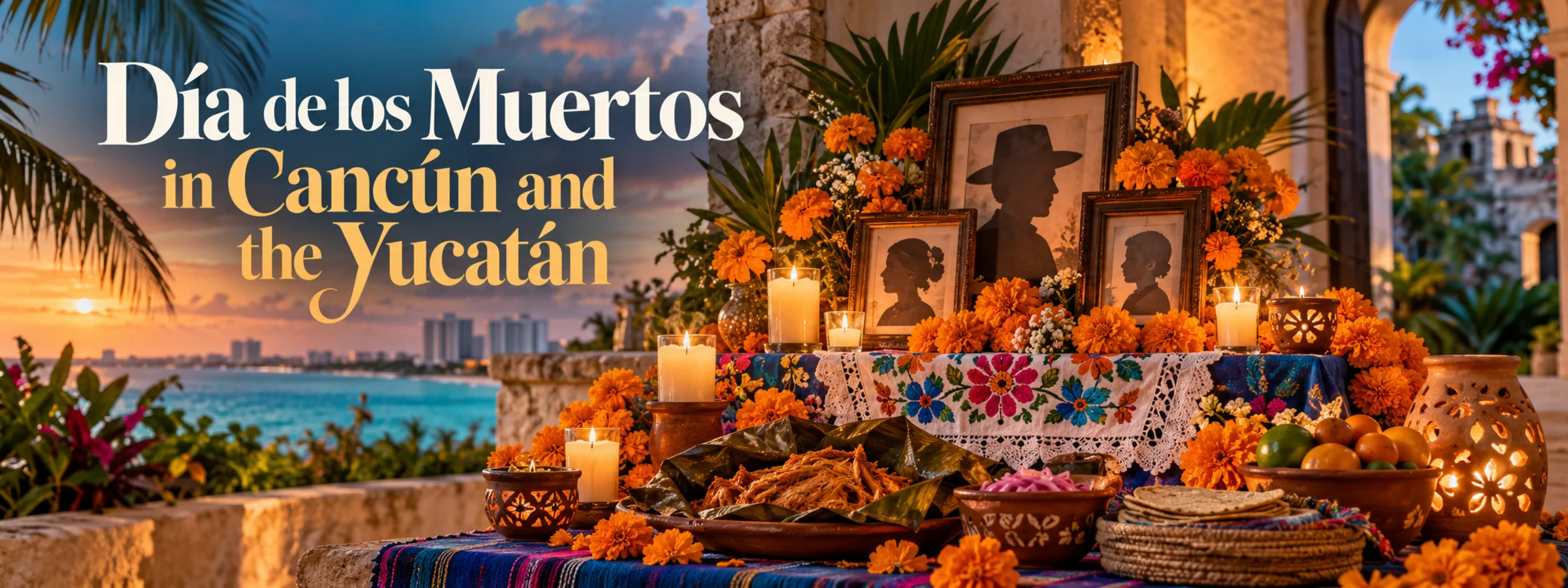

Día de los Muertos is easy to recognise in photographs and easy to misunderstand as a traveller. In Cancún and across the Yucatán Peninsula, I would approach it first as a period of family remembrance, not as a costume theme or a ready-made tourist spectacle.
The regional context matters. Yucatán has the living Maya tradition of Hanal Pixán — commonly translated as “food for the souls” — with its own foods, altars and sequence of remembrance. It overlaps with the wider Mexican Día de Muertos period without being interchangeable with every celebration elsewhere in the country.
The dates begin on 31 October in Yucatán
A simple “1–2 November” description misses the local sequence. Official Yucatán tourism information describes Hanal Pixán across three consecutive days: 31 October for deceased children, 1 November for deceased adults and 2 November for all souls. INAH likewise describes the three-day period from 31 October to 2 November.
Public programmes can sit around those dates and change every year, so I would check current municipal and cultural listings rather than copying last year’s festival schedule.
What Hanal Pixán means
Yucatán’s official tourism material explains hanal as food and pixán as soul. The tradition remembers deceased family and friends through offerings that maintain the relationship between living relatives and those who have died.
INAH frames Hanal Pixán as a living Maya/Yucatecan expression tied not only to memory but also to community, land and the agricultural cycle. That is a much deeper idea than treating it as the regional version of face paint.
Altars are about particular people
Family altars may include photographs, candles, flowers, incense, water, salt and food or drink associated with the deceased. Yucatán tourism information notes different treatment for children’s and adults’ altars, including colourful cloth, sweets and toys for children.
I would remember that a private altar is not generic decoration. If someone invites you to see one, follow their lead and ask before photographing it closely or photographing family members around it.
Pib, mukbil pollo and food for the souls
Food is central to the tradition. Official Yucatán material highlights mukbil pollo, also called pib or pibes in common usage: a large tamal associated with underground cooking, along with atole, fruit and other offerings. INAH also describes pibipollo and the underground cooking process as symbolically connected to burial, renewal and the agricultural cycle.
For a visitor, trying seasonal food from a legitimate market, bakery or restaurant can be a respectful way to engage with the period without inserting yourself into a family ritual.
Cancún is not Mérida — and that is fine
Cancún is a young tourism city with residents from across Mexico and the peninsula. You may see hotel displays, municipal altars, cultural programming and restaurant menus alongside family observances that are not public at all. Do not expect one street scene to represent “the real” celebration.
If your trip also includes Mérida or other Yucatán communities, you may encounter a stronger public Hanal Pixán identity. I would treat those differences as part of the region rather than ranking one place as more authentic than another.
Public event versus private remembrance
Public parades, cultural performances, museum activities and community altars are designed to receive audiences. Private homes, cemetery visits and family graves are different spaces. The fact that a cemetery gate is open does not turn every grieving family into a photo opportunity.
I would keep distance, speak quietly, obey local rules and ask permission before photographing people or personal altars. A wide photograph of a public installation is different from putting a camera into someone’s remembrance.
Calavera makeup has context
Decorative skull imagery and Catrina-inspired makeup are visible in public celebrations and artistic events across Mexico. That does not mean every memorial setting is a costume party. If a public event explicitly invites face painting or dress-up, follow the event context. I would not arrive at a private altar or cemetery assuming a theatrical outfit is appropriate.
Buying souvenirs responsibly
Seasonal markets can sell sugar skulls, papel picado, ceramics and other decorative work. If I buy something, I would rather buy from a local maker or established market stall than treat sacred or family-specific objects as props. Ask what an item represents when you are unsure.
Children can learn a lot here
Día de Muertos can be a meaningful family learning experience because it opens a conversation about memory, ancestors, food and regional culture. Explain before arriving that an altar may represent real people who died and that respectful behaviour matters even when the colours are festive.
How I would plan the visit
- Check current Cancún or Yucatán cultural programmes close to travel.
- Choose public events when you want photography and performance.
- Treat homes, graves and family altars as personal spaces.
- Try seasonal Yucatecan food and learn what it signifies.
- Do not reduce Hanal Pixán to a generic national Día de Muertos aesthetic.
My verdict
I would make time for a public Hanal Pixán or Día de Muertos event if my Cancún trip overlaps the period, but I would go to learn rather than collect a dramatic photograph. The most useful thing to carry away is the idea behind the tradition: memory is active, food carries meaning, and the dead remain part of family and community life.
Cheers, Carpe Diem & honour the memory behind the colour! 🍻⏳🕯️
TATS Man
The respectful observer who keeps the camera down when the moment belongs to a family